Hello, I’m an artist not a web designer so please bear with me as I redesign this site
In the meantime you can find my gallery at https/dimaarte.com
Feel free to contact with questions directly to drawtopaint@yahoo.com
.
As a member of an art group I’m often asked to support beginners to get started with drawing or how to paint. So I decided to develop a website to provide the basic concepts.
Drawing is often seen as a way to create images using hard instruments such as pencils, pens both hard and soft tipped, crayons and pastels. Pencils are the most popular and easiest found as is paper on which to draw.
Painting on the otherhand uses brushes and other flexible tips that can cover spaces quickly however the process of mark making is basically the same as drawing. Major differences involve the surfaces used for painting on, and the medium used. Watercolour painting uses paper of various types. Acrylics and oils can also use prepared papers, but stretched canvas or loose leaf pads are most popular, there are also a wide variety of solid surfaces including wood, hardboard, metal, creamics and glass.
The simplest way to get started is drawing with pencils.
So I’ll start with a discussion on pencils – the most common pencil that can be found anywhere is the HB which is the code for Hard Black. It is widely used in schools and offices, often its known a lead pencil, it is however a mixture of graphite and a binder held in a wooden sheath. A leading maufacturer of pencils is Derwent in Cumbria, England. They discovered deposits of graphite in Borrowdale Valley and began making pencils in 1832. They make a range of graphite pencils with degrees of hardness which combine graphite and blenders with china clay. Adding clay increases hardness, 9H being the hardest and 13B the softest.
Now there are many pencil manufactures that produce graphite pencils using similar methods – so use what is available and experiment with degrees of softness to find what best suits you.
The hardest pencils make extremely light marks which can be used to sketch a design. Its imortant to remember that hard pencils make light marks so don’t push hard as this will cause grooving the surface of the paper, also if they have a very sharp point they can cut paper
The softest provides the darkest marks without damaging the paper surface and can easily be lifted off with a soft eraser.
The Degrees of Hardness: 9H, 8H, 7H, 6H, 5H, 4H, 3H, 2H, F, H, HB, B, 2B, 3B, 4B, 5B, 6B, 7B, 8B, 9B,10B,11B,12B,13B
Now it’s time to look at Papers
For a start any paper will do to develop mark-making skills. There is a wide range of paper available on the market and I suggest the use of a Sketch Pad or a block of Cartridge Paper, these can be low cost suitable for trials – but also for serious sketching and drawings.
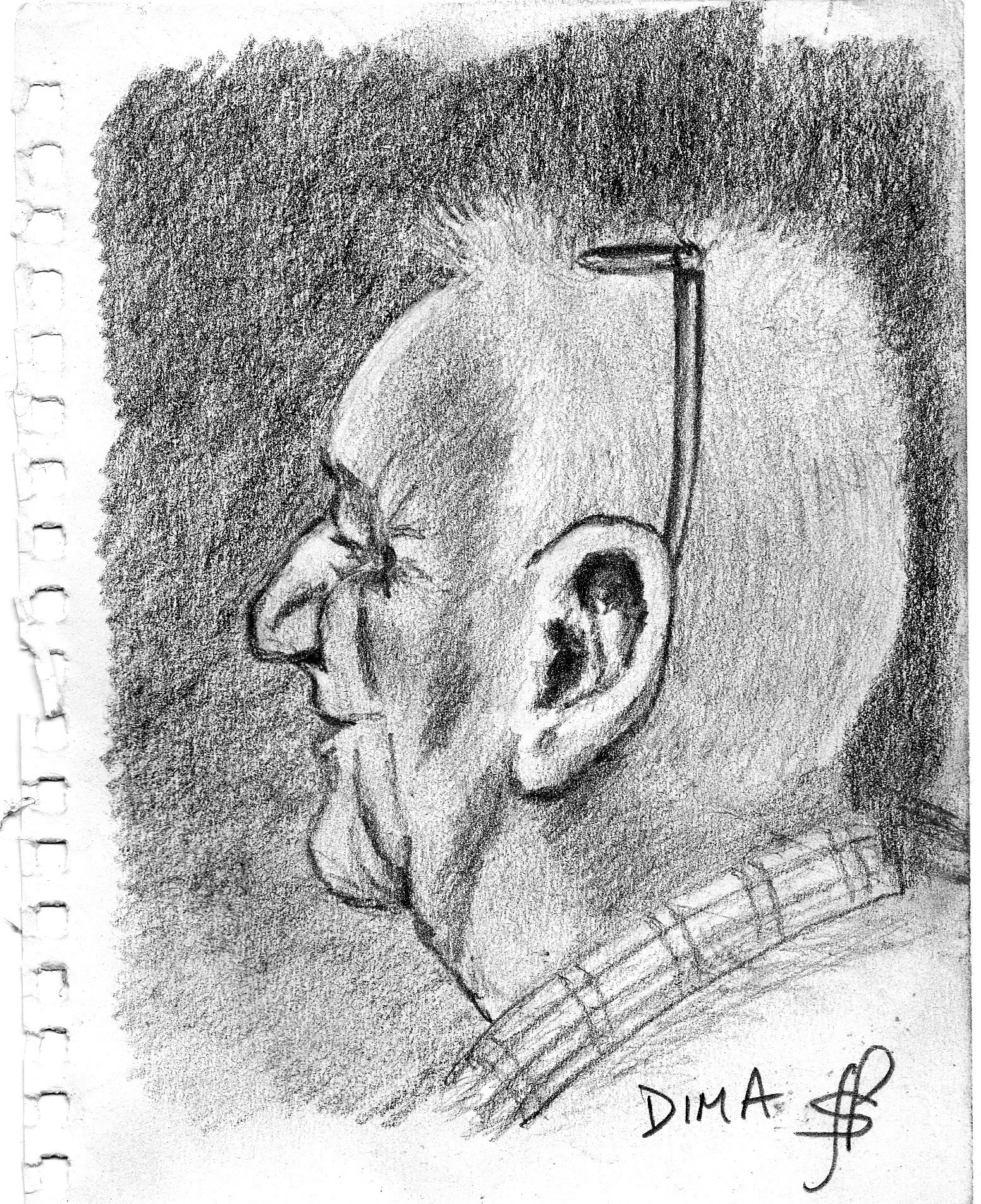
I often carry an A5 Sketchbook, B3 and B8 pencils, and an eraser, as I enjoy sketching portraits of interesting characters. Below is quick sketch I made of a man in a cafe, he was moving around a lot so I had to be patient to collect all the details. Materials were A5 Daler Sketchbook and B7 Derwent pencil.